Flat tire on your bike? Stay calm, you'll be riding again in 15 minutes
The sun is shining, the wind is ruffling your hair, you're riding a beautiful route around Lipno and suddenly – pssssss. The tire is going soft, the rim is grinding on the asphalt, and there it is.
A flat out on the trail is the number one nightmare for a lot of cyclists, and it's the reason they'd rather not head out alone. Needlessly so – and doubly so in the Lipno region. If you still don't know what to do on your own, an SOS car drives along the route around Lipno and will help you. But changing a tube really isn't rocket science, and with this guide you can do it yourself, even with just a coffee in your stomach, within 15 minutes.
Our partner MojeKolo.cz gives you the guide – they're the guys who know bikes, so we agreed they would share it with you all as well.
What to carry with you: the cyclist's “repair kit”
You don't have to haul a whole toolbox. Everything you need fits into a small saddle bag that you attach once and then it stays there all summer. Nowadays you can even find saddle bags with a tube and tire levers already inside – just pick the right size.
What shouldn't be missing from it:
Spare tube – the right size for your tire (29", 27.5" and so on) and the right valve type (Presta or Schrader).
Tire levers and patches (2 pcs) – without a tire lever it's hard to get the tire off the rim. The patches come in handy in case flat number two catches you on the same ride.
Mini pump – compact, it can even go on the bottle cage. Electric mini compressors, which fit right into a saddle bag and inflate the tire at the push of a button, are getting more and more popular. Or a CO2 cartridge, when you want air right away.
Multi-tool – in case the wheel can only come off with a hex key (modern bikes with thru-axles often need one).
Step by step: how to change a tube
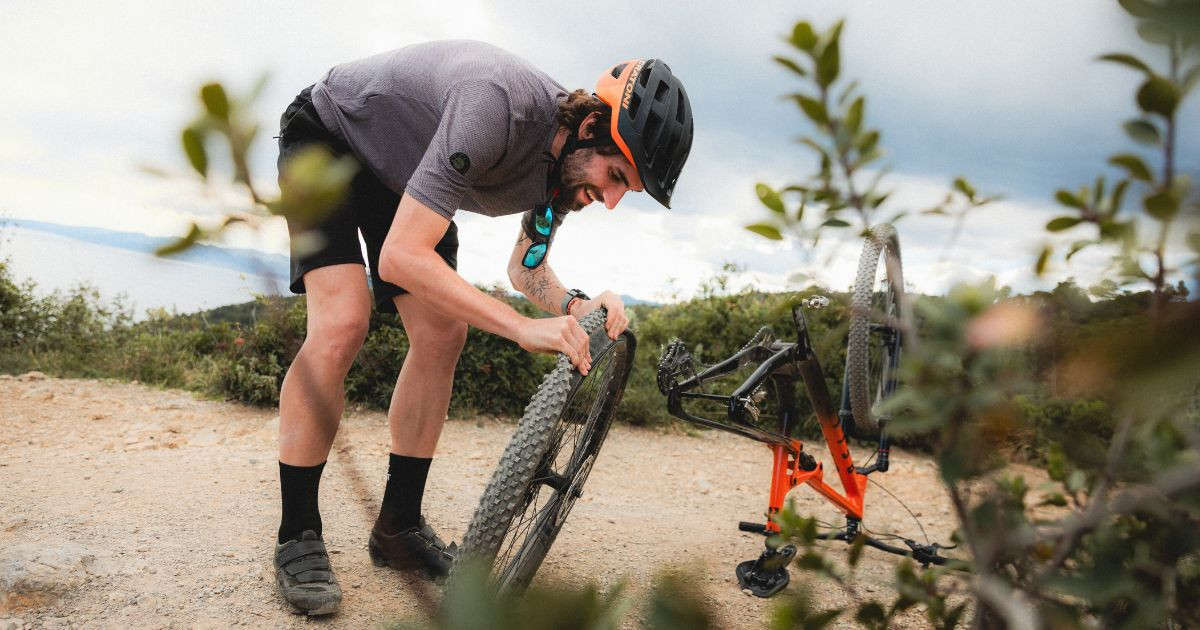
As soon as you feel you're riding “on the rim”, stop right away. Find a flat and safe spot off the road.
1. Take the wheel off. If the flat is at the rear, first shift onto the smallest cog on the cassette (the hardest gear) – the chain will go slack and the wheel will come out more easily. Release the quick release or pull out the thru-axle with a hex key and take the wheel out. Lay it on the grass, ideally not on the derailleur.
2. Take the tire off the rim. Let all the remaining air out. Push the tire beads toward the center of the rim so the tire isn't stretched tight. Slide the first tire lever under the edge of the tire and hook it on a spoke. Slide the second one in a little farther along (10–15 cm) and pull it around the rim – one side of the tire gets completely “peeled off” this way.
3. Pull out the old tube and find the culprit. Unscrew the nut from the valve and take the tube out. Careful, this is the key step: gently feel along the inside of the tire with your fingers and find what caused the flat (a thorn, glass, wire). If you leave the culprit inside, you'll puncture the new tube right after inflating it.
4. Put in the new tube. Inflate it a little so it holds its shape and doesn't get twisted. Push the valve into the hole in the rim and gradually tuck the tube under the tire.
5. Put the tire back on and inflate. Push the edge of the tire into the rim with your hands. The last bit goes on stiffly – help yourself with a tire lever, but carefully, so you don't pinch the new tube. Check that the tube isn't sticking out anywhere, tighten the valve nut and inflate to the required pressure.
Finale: the wheel back in the frame
Put the inflated wheel back in. At the rear, thread the chain onto the smallest cog again, carefully slide the wheel into the frame, tighten the axle to the recommended torque or close the quick release, and check that the wheel spins freely and doesn't rub on the brakes. Done – tools back in the saddle bag and you keep pedaling.
This guide was prepared for you by our partner MojeKolo.cz.