
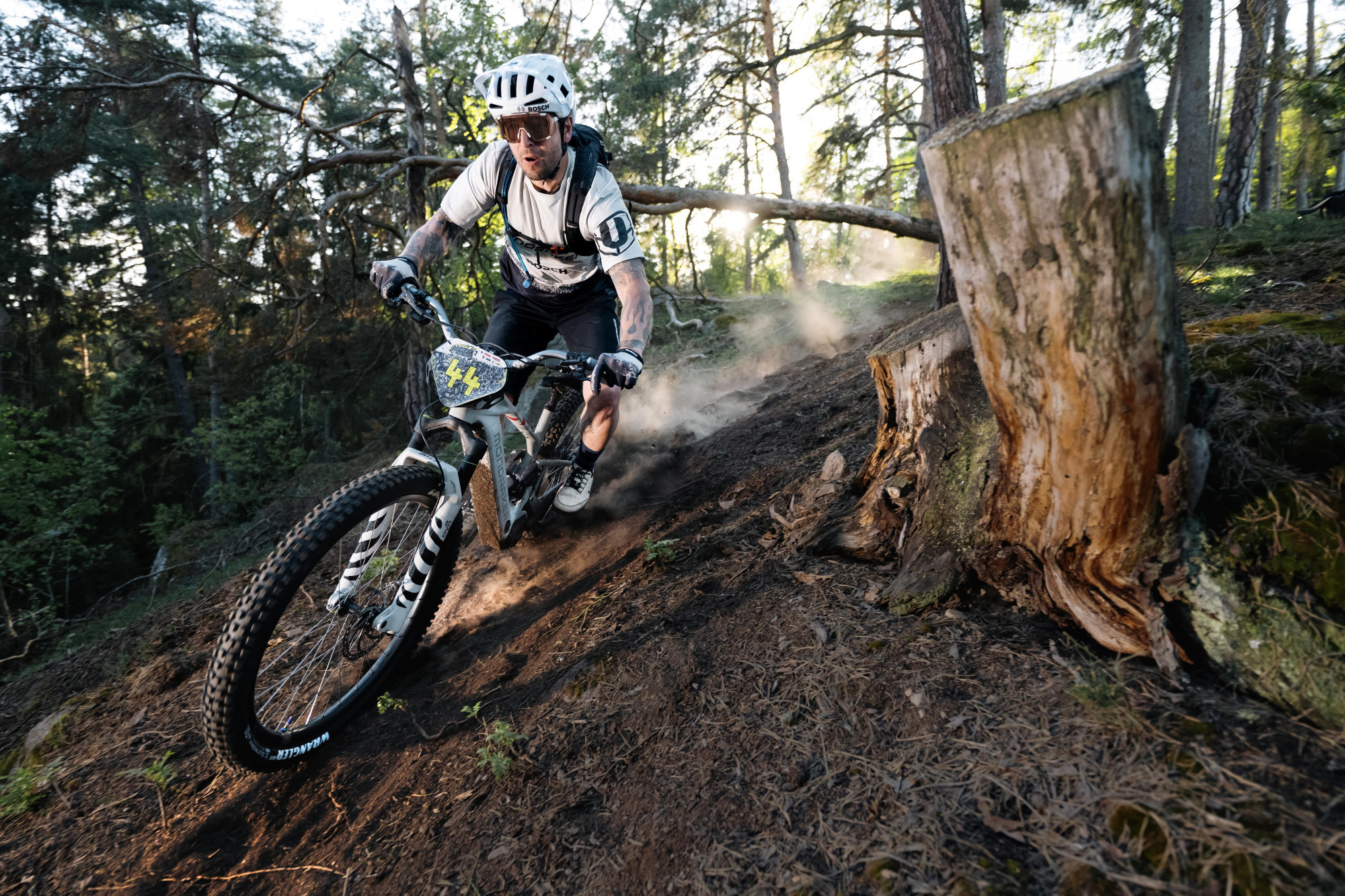
How to brake?
Are you afraid you won't brake in time, or that you'll fall while braking? To avoid that, you need to have your brake levers set up correctly and work with your body's balance. Professional e-biker and Bosch eBike Systems ambassador Richard Gasperotti lists the most common mistakes cyclists make when braking on an e-bike and shares tips on how to fix them.
1. Adjust the height of your brake levers
If you want to brake well, you need to have the tool that triggers the braking within easy reach, and that means the brake levers. Surprisingly many people get on the bike just as it was put together at the shop and worry about nothing more than the saddle height. Yet the position of the levers on the handlebars determines how quickly you can react to a situation.
If the levers are too high, you “break” your wrists when braking. If they are too low, on the other hand, they are harder to reach and you lose precious time when braking. In both cases you also lose control of the handlebars, and with it of the whole bike.
The correct setting is one where your index fingers resting on the levers form a straight line with your forearms.
2. Use both brakes at the same time
You brake with one finger placed at the end of the lever, where the lever has its longest travel. This lets you modulate braking sensitively and make full use of leverage.
People are sometimes afraid that if they use the front brake they will fly over the handlebars, so they would rather leave it out. That is a huge mistake, because when you brake with the rear brake only, the braking distance can grow by 150 to 200%.
3. Place your foot correctly on the pedal and work with your balance
How effectively you use the power of the brakes also depends on your position on the bike. It starts with the correct foot position on the pedal and ends with your body posture.
Your foot should sit on the pedal so that the pedal axle passes under the joint of your big toe, that is, roughly between the first and second third of your foot.
Your center of gravity should be above the top tube. Ideally, when braking hard, don't sit on the saddle but keep your body slightly crouched above the frame.
A common mistake is that people shift their center of gravity behind the saddle when braking, out of fear of flying over the handlebars. But that significantly reduces the effectiveness of the front brake and at the same time increases the risk of the rear wheel skidding. If they unload the front wheel like this in a corner – even a gentle one – they easily lose traction and slide out, which almost always leads to a quick fall.
4. Use ABS
This advantage is available to e-bike riders, for whom Bosch eBike Systems has developed a system analogous to the ABS brake assistant from cars and motorcycles.
E-bikes are heavier than classic bikes because of the motor and battery, and the higher weight naturally lengthens the braking distance. ABS prevents the wheels from locking during hard braking and, according to the manufacturer, can prevent up to 30% of falls. At the same time, it helps prevent flying over the front wheel.
Riders with ABS can therefore brake hard and more safely, without having to fear a skid.
5. Keep your braking system in perfect condition
It goes without saying that brakes should be in good order. I recommend having your bike checked and adjusted at a quality bike service before the start of every season.
The most common problem with today's most widespread disc brakes is worn brake pads. You can tell they need replacing not only from the extreme situation where sparks fly off the discs, because that is truly a critical state. Often it is enough that they start making a metallic sound when braking.
New pads are not expensive, and most cyclists can replace them by following the instructions. On e-bikes it is advisable to check the condition of the pads more often, because the higher weight causes faster wear.